
SiteBook’s Residential Builder Compliance Guide
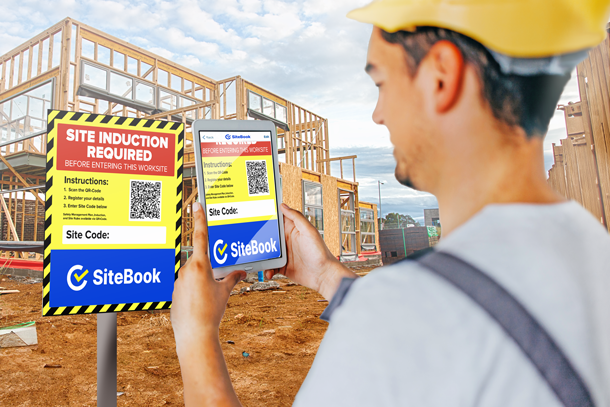
Is Your Site Compliant? Here’s a handy guide to the records, checks, and safety systems residential builders should have in place when managing a worksite.
Responsibility runs through the whole business
WHS duties can overlap. Responsibility does not simply pass from the Principal Contractor to a supervisor or subcontractor.
Likewise, appointing a supervisor, safety manager, or subcontractor does not remove the Principal Contractor’s duties or a director’s personal due-diligence obligations.
Principal Contractor Responsibilities
Directors and Officers must exercise due diligence: ensure suitable systems, tools and resources exist and take reasonable steps to verify they are being used. It is their responsibility to ensure that a WHS Management System is in place.
Site managers and Supervisors are responsible for ensuring the WHS Management System is put into practice by checking access, inductions, licences and SWMS; responding to hazards; coordinating trades; and stopping unsafe work.
| THE REAL TEST If an incident occurs or an inspector attends site, will you be able to demonstrate what was checked, communicated and monitored – and when? |
Contractor and Worker Responsibilities
- Contractors and Subcontractors remain responsible for their own business, workers, work activities, SWMS and control measures.
- Workers must follow reasonable instructions, site procedures, SWMS and required controls, and report unsafe conditions.
If something goes wrong, investigators may ask:
- Did directors provide adequate systems, tools, resources and oversight?
- Did supervisors implement and monitor those systems on site?
- Did contractors provide competent people and safe procedures?
- Were the required controls actually followed?
| BOTTOM LINE: More than one business or individual may be held responsible for the same incident. Failures can lead to notices, stopped work, prosecution, financial penalties and reputational damage. |
THE SIX-POINT SITE CHECK
Could You Prove Your Compliance?
1. Display required site signage
In SA, signage is required for construction projects valued at $450,000 or more. It must be visible from outside and show the Principal Contractor’s name, provide a 24-hour contact number, and site-office location.
2. Verify White Cards and required licences
The principal contractor will must confirm that each worker has completed general construction induction training (white card course) and check for any High-Risk Work Licences or competencies required for the actual work. Do not rely on assumption or verbal confirmation.
3. Obtain site-specific SWMS
People doing high-risk work must have a site-specific SWMS prepared before work starts. It must address the specific site, work, conditions, hazards and control measures. A generic SWMS that has not been prepared for the site and work should not be accepted. The work must then follow the SWMS in practice.
4. Assess contractors before they start
Principal contractors should always confirm a contractor’s work licence, Public Liability Insurance, ReturnToWorkSA or workers compensation arrangements, and Personal Accident Insurance where relevant. Confirm each record belongs to the correct business, is current and covers the contracted work.
| BUILDER EXPOSURE: In SA, engaging an unlicensed person for work requiring a licence can attract a $5,000 expiation fee or a maximum penalty of $500,000. Missing insurance can also lead to claims, disputes, rejected cover, delays and recovery costs. |
5. Provide a site-specific induction
Before starting, all workers should understand site access, hazards, emergency arrangements (evacuation assembly point, nearest hospital), PPE requirements, site rules, incident reporting procedures, and any relevant SWMS. A White Card does not replace a site-specific induction.
6. Maintain a WHS Management Plan when required
In SA, a written plan is required before work starts on a construction project valued at $450,000 or more. It must identify responsibilities, consultation, incident arrangements, site rules and SWMS management. Below $450,000, general WHS duties still apply.
How SiteBook helps
SiteBook centralises the evidence your business may need to produce:
- Contractor prequalification, business licences and insurance
- Worker details, White Cards, licences, cards and tickets
- Inductions, site-specific SWMS and Safety Management Plans
- Attendance, expiry dates and auditable compliance records
| DON’T WAIT FOR AN INCIDENT: Review your processes before the next contractor or worker arrives. Talk to SiteBook about keeping compliance evidence accessible to directors and supervisors in one central system. |
